At LoanMaaf, we talk to people going through loan settlement every single day — so we’re not writing this from a textbook, we’re writing it from what we actually see happen at the negotiation table. If you’ve searched “personal loan settlement kaise hota hai” or “how do I get a settlement on my personal loan,” this guide walks you through the real process, in plain language, exactly the way our team explains it to clients before they start.
What Is Personal Loan Settlement, Really?
In simple terms, personal loan settlement is when your lender agrees to accept less money than you actually owe, and in return, marks your loan as closed. It’s not a loophole and it’s not “free money” — it’s a negotiated compromise that happens because the lender believes getting something now is better than chasing the full amount for years.
It’s important to separate this from loan closure. Closure means you paid back everything you owed, on the original schedule. Settlement means you paid back a reduced amount, and your lender agreed to write off the rest. Both end the loan — but they’re reported very differently to credit bureaus, which we’ll get into further down.
When Does a Loan Become Eligible for Settlement?
In our experience, lenders don’t usually even discuss settlement until a loan has crossed a certain point of default — typically once payments have been missed for around 90 days to 6 months, and the account has been internally classified by the bank as a Non-Performing Asset (NPA). Before that point, most banks would rather work out a restructuring plan than a settlement, because settlement means they’re accepting a loss.
This is one of the most common misunderstandings we see: people reach out to us in month one of missing a payment, hoping to “settle” immediately — but at that stage, restructuring or a short repayment extension is usually the more realistic (and less damaging) option. Settlement becomes a genuine conversation once the account has aged into serious default territory.
The Personal Loan Settlement Process, Step by Step
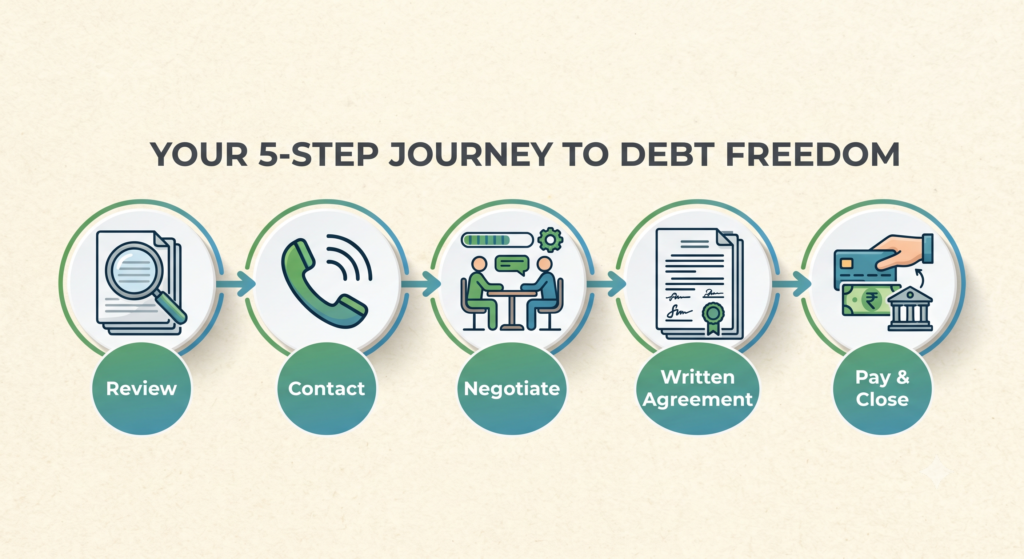
Here’s exactly how the process plays out, based on the negotiations our team handles regularly.
Step 1: Financial Hardship Review
Before you approach a lender, you need to be able to show why you can’t repay in full — job loss, a medical emergency, business failure, or a similar genuine hardship. Lenders don’t settle simply because someone doesn’t feel like paying; they settle when the numbers show that full recovery is genuinely unlikely. We usually start by helping clients lay out their total outstanding debt against their current income, so the hardship case is clear and honest before we even pick up the phone.
Step 2: Contact the Lender’s Collections or Settlement Team
Once the case for hardship is clear, the next step is reaching out — usually to the bank or NBFC’s collections or recovery department, not your regular customer service line. This is where a lot of people get stuck or intimidated, especially if recovery agents have already been calling. (If that’s happening to you, our guide on handling recovery agent calls and knowing your legal rights is worth reading alongside this one.)
Step 3: Negotiation
This is the step where most people either save a significant amount of money — or leave a lot on the table. In our day-to-day negotiations, settlements typically land somewhere between 40% and 70% of the total outstanding dues, and where you land within that range depends heavily on how long the account has been in default, how firmly the hardship case is presented, and honestly, how the negotiation itself is handled. This is exactly the part of the process where having someone experienced on your side tends to make the biggest financial difference — it’s rarely the bank’s first offer that’s their best one.
Step 4: Get a Written Settlement Letter
We cannot stress this enough, because we’ve seen the consequences of skipping it: never pay a single rupee based on a verbal agreement. Always insist on a formal, signed settlement letter from the lender before making any payment. This letter should clearly state the agreed settlement amount, the payment deadline, and confirmation that the remaining balance will be waived once paid. Without this in writing, you have no protection if there’s a dispute later.
Step 5: Payment and Closure
Once the written agreement is in hand, the lump-sum payment is made, and — this is the step people most often forget to follow up on — you should formally request a No Dues Certificate (NDC) from the lender. This document is your official proof that the debt has been cleared according to the agreed terms. Keep it safely; you may need it for years if any discrepancy ever comes up on your credit report.
Personal Loan Settlement Kaise Hota Hai? (Quick Summary)
Agar aap simple bhasha mein samajhna chahte hain: jab aap apni personal loan ki EMI kaafi mahino tak nahi bhar paate, toh bank aapka loan “NPA” mark kar deta hai. Uske baad aap bank se baat karke, apni financial dikkat batakar, ek kam amount mein loan settle karne ki request kar sakte hain. Bank agar maan jaye, toh aapko ek likhit settlement letter milta hai, jisme decided amount aur deadline likha hota hai. Wo amount pay karne ke baad, aapko No Dues Certificate milta hai — jo proof hota hai ki aapka loan clear ho chuka hai. Lekin dhyaan rahe, is process mein aapka credit score kaafi neeche ja sakta hai.
How Settlement Affects Your Credit Score
This is the part every client asks about, and it’s worth being upfront: settlement is not a free pass.
- Your credit report will show the account status as “Settled” — not “Closed” and not “Paid in Full.” Credit bureaus and future lenders can see this distinction clearly.
- Most people see their credit score drop by roughly 75 to 100 points after a settlement is reported.
- That “Settled” tag typically stays visible on your credit history for up to 7 years, which can make new loans or credit cards harder to get approved during that window.
If your goal after settlement is to rebuild your score, our guide on how to improve your CIBIL score is a good next read — most of our clients start there right after closing a settlement.
Is Settlement Right for You? (Quick Self-Check)
Before deciding, ask yourself honestly:
- Have I already missed payments for several months, with no realistic way to catch up?
- Have I explored restructuring or an EMI extension with my lender first?
- Am I okay with a temporary drop in my credit score in exchange for closing this debt now?
- Do I have a lump sum available (even if smaller than the full loan) to offer?
If you checked most of these, settlement is worth a real conversation. If you’re earlier in the process — say, you’ve only missed one payment — it’s usually worth exploring restructuring first. Talk to our settlement team about your specific situation →
Frequently Asked Questions
How do I get a settlement on my personal loan? You start by contacting your lender’s collections or settlement department directly, presenting your financial hardship, and negotiating a reduced lump-sum amount. Getting the final terms in writing before paying is essential.
How much settlement is typical for a personal loan in India? Based on what we see in negotiations, settlements usually range between 40% and 70% of the total outstanding amount, depending on how long the loan has been in default and how the negotiation is handled.
Can I settle a personal loan before it becomes an NPA? It’s uncommon. Most lenders only seriously consider settlement once an account has been in default for around 90 days to 6 months. Before that, restructuring is usually the more realistic path.
Will my credit score recover after a settlement? Yes, over time — through consistent on-time payments on any remaining or new credit lines, keeping credit utilization low, and simply letting the settlement age past the 7-year reporting window. It’s a gradual rebuild, not an overnight fix.
Do I need a written agreement before paying a settlement amount? Always. Never make a settlement payment based on a verbal promise from a bank representative — insist on a signed settlement letter first.
Written by the LoanMaaf Financial Expert Team
Our team works directly with borrowers negotiating loan and credit card settlements with Indian banks and NBFCs, and writes from that hands-on negotiation experience — not just published guidelines. Have questions about your own situation? Get in touch with us for a free, confidential review.
Published: [29.07.2026] | Last updated: [29.07.2026]