
Personal loan settlement rules in India are now stricter and more standardised than ever, thanks to the RBI’s Master Direction on Compromise Settlements and the fresh borrower-protection circulars rolled out through 2026. If you’re behind on EMIs and considering a settlement with your bank or NBFC, understanding these personal loan settlement rules before you pick up the phone can save you lakhs of rupees — and years of credit damage.
This guide breaks down every rule that governs personal loan settlement, bank loan settlement rules, and answers the question everyone is Googling right now: what are the new rules for loan settlement in 2026.
What Is Personal Loan Settlement?
A personal loan settlement is a formal, written agreement in which your lender agrees to accept a reduced lump-sum payment to close an overdue loan account, waiving the remaining balance. It is not a waiver out of goodwill — it’s a business decision. The bank calculates the cost of chasing the full amount through recovery or litigation versus accepting a partial payment now, and often the partial recovery wins.
Settlement is meant strictly for genuine financial hardship — job loss, medical emergencies, or a severe, sustained drop in income. It is a last resort, not a shortcut to erase debt cheaply.
1. The Legal Backbone: RBI’s Master Direction on Compromise Settlements
The single most important of the personal loan settlement rules is this: every bank, NBFC, and small finance bank in India must follow the RBI’s Comprehensive Regulatory Framework for Compromise Settlements and Technical Write-offs (Circular RBI/2023-24/40, dated 8 June 2023). This circular replaced the old patchwork of bank-specific policies with one uniform rulebook for all Regulated Entities (REs).
Key points from the framework that shape every bank loan settlement rules discussion:
- Every regulated entity must have a Board-approved policy covering how compromise settlements and technical write-offs are conducted, including conditions like minimum ageing of the account and deterioration in collateral value.
- The authority approving a settlement must be at least one level senior to the official who originally sanctioned the loan, and staff who sanctioned the loan cannot be involved in approving its settlement — this prevents conflicts of interest.
- Once you settle, the lender cannot extend you fresh credit (other than farm credit) for a minimum of 12 months from the settlement date, unless the bank’s own policy sets a longer cooling-off period.
- If your repayment of the agreed settlement amount stretches beyond three months, RBI treats the arrangement as a “restructuring” instead of a straightforward settlement — a different regulatory category with its own reporting rules.
2. Eligibility: When Can You Actually Ask for a Settlement?
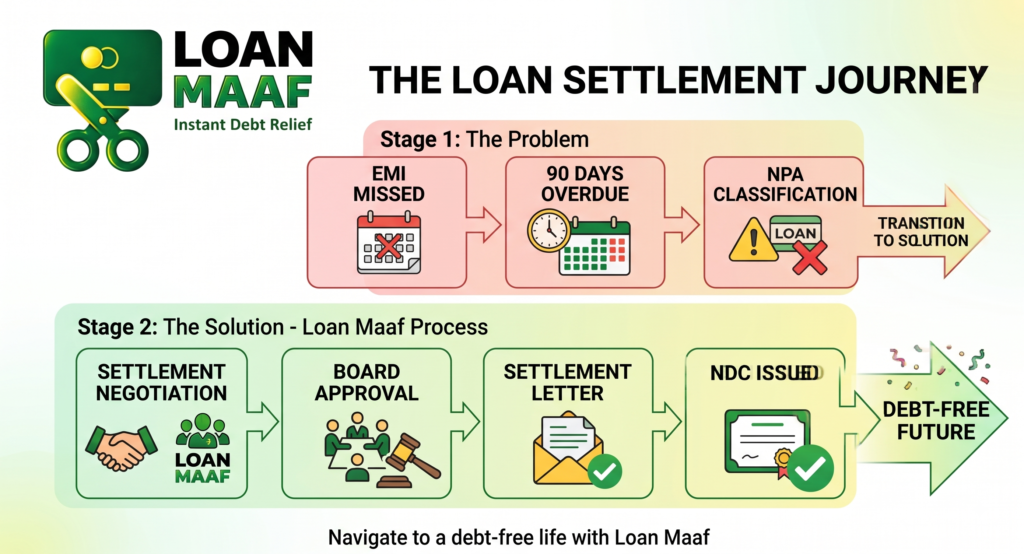
Banks won’t even discuss settlement unless you meet these conditions:
| Condition | Typical Requirement |
|---|---|
| Loan status | Marked as Non-Performing Asset (NPA) — 90+ days past due |
| Overdue duration | Most banks only consider settlement once the loan has been marked NPA, generally after 90 days of missed EMIs, though many banks wait 120–180 days before opening talks |
| Proof required | Job-loss letter, medical bills, hospital records, or income-drop proof (salary slips, bank statements) |
| Loan types covered | Personal loans, credit cards, BNPL, and loan-app debt — this guide does not cover home, auto, or gold loans, which follow separate secured-loan recovery rules |
Genuine hardship documentation matters — a bank is far more likely to approve a fair settlement percentage if you can prove the hardship rather than simply asking to pay less.
3. Bank Loan Settlement Rules: How the Negotiation Actually Works
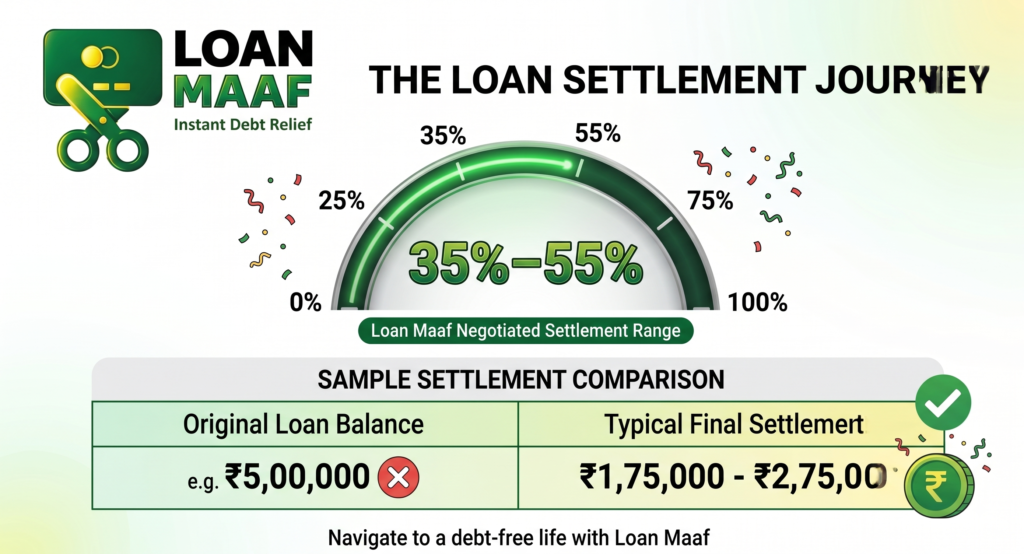
For unsecured personal loans, settlements typically land between 35% and 55% of the total outstanding dues, depending on:
- The bank’s internal write-off policy
- How long the account has been overdue
- Your documented ability to pay
- Whether the account has already been sold to an Asset Reconstruction Company (ARC)
Negotiation tips that align with the rules:
- Never accept a verbal settlement offer — a settlement changes your credit obligations only when it follows the bank’s board-approved process, so get everything in writing.
- Ask for the “Full and Final Settlement” letter before you pay a single rupee.
- Confirm the exact settlement amount, payment deadline, and what happens if you miss it.
- Request written confirmation of how the account will be reported to CIBIL/Experian/CRIF.
4. What Are the New Rules for Loan Settlement in 2026?
This is where most existing blogs on personal loan settlement rules go out of date — 2026 brought real changes, mostly around how lenders can pursue you before and during settlement talks:
- Stricter recovery-agent conduct rules. RBI’s rules restrict recovery agents to contacting borrowers only between 8:00 AM and 7:00 PM, and agents are now forbidden from contacting a borrower’s friends, relatives, or colleagues.
- Complaint-first protection. Under the new framework, if you file a grievance about unfair recovery practices, the bank must address the complaint before the account can be referred onward for further recovery action.
- New Ombudsman timeline (RB-IOS 2026). Under the Reserve Bank Integrated Ombudsman Scheme 2026, you must first approach your bank or NBFC directly; if you don’t get a response within 30 days, or you’re unhappy with the reply, you can escalate to the RBI Ombudsman within 90 days of that deadline.
- Compensation for harassment. The RBI Integrated Ombudsman can award compensation of up to ₹20 lakh in proven cases of borrower harassment during recovery, and it operates entirely free of cost.
- Device-locking limits on digital loans. New RBI directions for NBFCs and Housing Finance Companies bring recovery-agent standards in line with banks, including tighter rules on when lenders can remotely restrict a financed device.
- Advance notice for agent visits. Recovery agents are now required to give prior written notice before a physical visit, and abusive conduct or unannounced doorstep visits are explicit violations you can report.
If you’re negotiating a settlement in 2026, these rules matter just as much as the settlement percentage — they define what a lender is legally allowed to do to you while you’re negotiating.
5. Documents You Must Collect — Non-Negotiable
Before you pay a single rupee toward a settlement, insist on these three documents:
- Signed Settlement Letter — states “Full and Final Settlement,” the exact amount, and the deadline.
- No Dues Certificate (NDC) / No Objection Certificate (NOC) — your permanent legal proof that the debt is settled, issued after you’ve paid the agreed amount.
- CIBIL/Credit Bureau Update Confirmation — written confirmation of how and when the lender will update your credit report.
Without these, you have no legal proof the debt was ever closed — and defaulted accounts have resurfaced years later when lenders “forgot” to update the bureau.
6. Impact on Your CIBIL Score
This is the trade-off every borrower needs to understand clearly.
| Loan Closure (Full Repayment) | Loan Settlement | |
|---|---|---|
| CIBIL status shown | “Closed” | “Settled” |
| Score impact | Positive / neutral | Drops your CIBIL score by roughly 75–100 points |
| How long it stays visible | N/A (positive history) | Up to seven years on your credit report |
| Future loan approvals | Normal | Most banks will decline home, car, and business loan applications for the duration the “Settled” tag remains visible |
The good news: if you later pay off the written-off balance and get an NOC, you can request the bureau update your status from “Settled” to “Closed,” which can recover a meaningful chunk of the lost score over 6–12 months.
7. The Cooling-Off Period
Regulated lenders are barred from extending you any fresh credit — personal loan, credit card, or otherwise — from the same institution for a minimum of 12 months after a settlement, and some banks set this even longer in their own board-approved policy. This is a direct consequence of the RBI’s 2023 framework and applies uniformly across banks and NBFCs.
Step-by-Step: How to Settle a Personal Loan the Right Way
- Check your NPA status — confirm with the bank how many days overdue your account is.
- Gather hardship proof — job-loss letter, medical bills, or income documentation.
- Request a settlement in writing — email or written application, not just a phone call.
- Negotiate the percentage — aim within the 35–55% range for unsecured loans; don’t accept the first offer.
- Get the settlement letter — with amount, deadline, and reporting terms in writing.
- Pay through a traceable method — cheque, NEFT, or RTGS; avoid cash.
- Collect the NDC/NOC — your permanent proof of closure.
- Track your CIBIL report — confirm the “Settled” status appears within 30–45 days of payment.
Frequently Asked Questions
Is loan settlement bad for my CIBIL score?
Yes — it typically causes an immediate drop of 75–100 points and the “Settled” tag remains visible for up to seven years, but it’s still generally less damaging long-term than continued default.
Can I get a fresh loan after settlement?
Not from the same lender for at least 12 months. Other lenders may still approve you, though many will scrutinise a recent “Settled” tag closely.
What’s the difference between settlement and technical write-off?
A settlement involves an actual waiver of your outstanding claim; a technical write-off is only an internal accounting entry by the bank and does not waive your liability or stop recovery efforts against you.
Are recovery agents allowed to call me anytime?
No. Under current RBI rules, agents can only contact you between 8 AM and 7 PM, and they cannot contact your friends, relatives, or colleagues about your loan.
Final Word
The personal loan settlement rules in India exist to make this process fair, documented, and predictable — not a backroom negotiation. Know your NPA timeline, negotiate from a position of documented hardship, get everything in writing, and track the CIBIL fallout before you commit. If recovery calls or agent behaviour cross the lines set out above, you now have a formal, time-bound path to the RBI Ombudsman.